
India Medical Devices Market to reach USD 39.95 Billion by 2035 at 8.3% CAGR
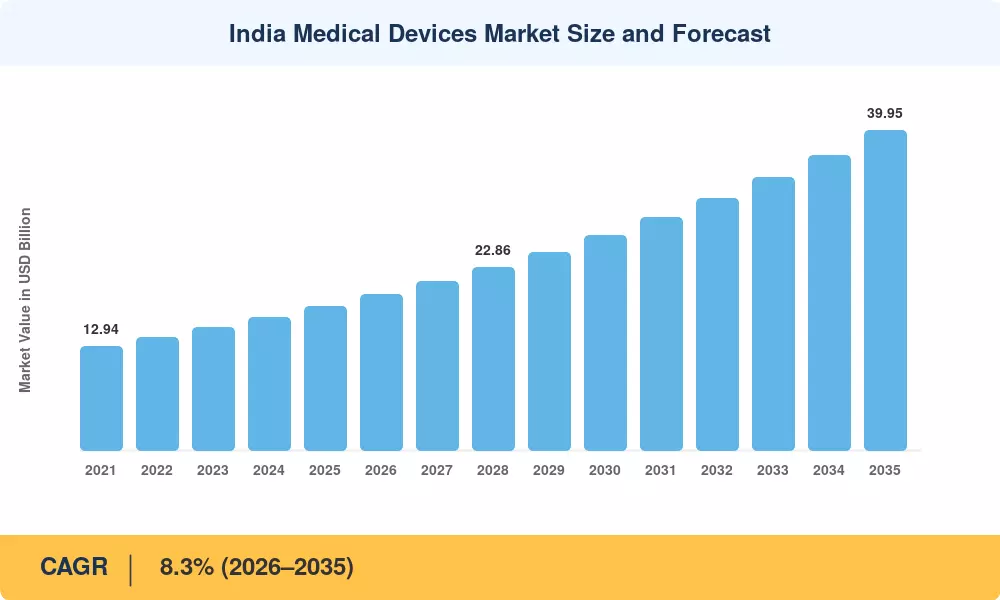
India Medical Devices Market to Surge from USD 19.49 Bn in 2026 to USD 39.95 Bn by 2035—By PLI-Backed Domestic

Press Release Disclaimer: This is a press release distributed through the XPR Media network. It has not been independently verified by our newsroom.

India Medical Devices Market to Surge from USD 19.49 Bn in 2026 to USD 39.95 Bn by 2035—By PLI-Backed Domestic Manufacturing, Digital Health Infrastructure
NY, CA, UNITED STATES, August 25, 2026 /EINPresswire.com/ — As per Market Research Future, the India Medical Devices Market size is projected to reach USD 39.95 Billion by 2035 from USD 19.49 Billion in 2026, at a CAGR of 8.3% during the forecast period 2026–2035. The market base was estimated at USD 18.00 Billion in 2025.
The 8.3% CAGR—anchored by structural shifts in healthcare policy, manufacturing, and technology adoption—is propelled by three converging forces: government-backed manufacturing incentives, particularly the Production-Linked Incentive (PLI) scheme that has seeded twenty-two greenfield plants with cumulative sales of approximately INR 12,344 crore (USD 1.48 billion) and exports of INR 5,869 crore (USD 703 million), strengthening domestic manufacturing and reducing import dependence; expanding public health procurement under the Ayushman Bharat Pradhan Mantri Jan Arogya Yojana (PM-JAY), which covers roughly 550 million beneficiaries and has pulled tertiary-grade equipment procurement into district hospitals that previously purchased almost nothing above basic consumables; and the digital health transformation, with the Ayushman Bharat Digital Mission issuing more than 700 million health accounts and interoperability standards enabling connected devices to push readings directly into longitudinal records.
Government and multilateral health organizations are amplifying this momentum. The National Medical Devices Policy 2023 targets a USD 50 billion domestic market by 2030 and has allocated funding for four dedicated medical device parks, backed by approximately INR 400 crore in central government funding. India’s diabetic population is estimated at 101 million, with a further 136 million pre-diabetic, and cardiovascular disease accounts for roughly 28% of all deaths nationally. The PLI scheme for medical devices has committed INR 3,420 crore across four target segments—cancer care equipment, radiotherapy devices, imaging systems, and implants—with disbursement tied to incremental sales thresholds.
Request A Free Sample:
https://www.marketresearchfuture.com/sample_request/17774
Key Market Trends & Growth Drivers
Production Incentives Reshaping Supply
The PLI scheme for medical devices has directly strengthened India’s domestic manufacturing base and reduced reliance on imported devices. Twenty-two plants have been commissioned, and their combined output has displaced an estimated 11% of previously imported high-end radiotherapy and CT volume. Import dependence, historically near 80%, has begun a slow slide toward the low seventies. That shift matters less for headline growth than for margin structure: domestically assembled units carry roughly 14–18% lower landed cost, which lets manufacturers price into district hospitals that previously bought refurbished equipment.
Chronic Disease Burden
India’s diabetic population is estimated at 101 million, with a further 136 million pre-diabetic, and cardiovascular disease accounts for roughly 28% of all deaths nationally. Screening programmes under the National Programme for Prevention and Control of Non-Communicable Diseases have widened point-of-care testing at more than 200,000 health and wellness centres. Each incremental screening tier converts into recurring consumable demand—test strips, lancets, ECG electrodes—which is why monitoring devices outpace capital equipment on growth even though their absolute revenue base is smaller.
Public Insurance as a Procurement Engine
PM-JAY covers roughly 550 million beneficiaries and has processed cumulative hospital admissions exceeding 80 million, with cardiology and orthopaedics among the highest-value packages. Empanelled hospitals must meet minimum equipment standards, which forces capital purchases that would otherwise have been deferred. The effect is most visible in Bihar, Odisha and Chhattisgarh, where empanelment growth has run well ahead of the national average and where installed imaging base per million population remains under half the national figure. The National Health Authority broadened PM-JAY coverage to all citizens aged 70 and above in May 2025, adding an estimated 45 million beneficiaries and lifting geriatric device demand.
Digital Health Infrastructure
The Ayushman Bharat Digital Mission has issued more than 700 million health accounts and registered upward of 400,000 verified health professionals. Interoperability standards let connected devices push readings directly into longitudinal records, which changes the purchase calculus for tele-ICU consoles and networked vitals monitors. Hospitals buying today increasingly specify HL7-FHIR compatibility as a tender requirement rather than a nice-to-have.
Ask for Customization:
https://www.marketresearchfuture.com/ask_for_customize/17774
Market Segment Insights
BY DEVICE TYPE
Therapeutic Devices: Dominant segment with 33.10% share in 2025, led by cardiovascular and orthopaedic implants. Implant and interventional volumes scale directly with insured procedure counts.
Diagnostic Imaging: Significant segment at USD 4.03 Billion in 2025, driven by district hospital imaging build-out.
Monitoring Devices: Fastest-growing device type at 9.14% CAGR (2026–2035) , driven by chronic disease screening and home care. Consumables attach at high frequency, and replacement cycles measure in months rather than years.
Surgical Devices: Holds 18.4% share in 2025, driven by minimally invasive procedure adoption.
BY TECHNOLOGY PLATFORM
Conventional Electro-Mechanical and Disposable: Largest segment with 39.78% share in 2025, still the default installed base across public hospitals. Public procurement replaces on failure rather than on schedule.
Augmented and Virtual Reality Solutions: Fastest-growing technology at 9.38% CAGR (2026–2035) , concentrated in twelve to fifteen high-volume surgical centres where training throughput justifies the capital.
Wearable and Remote Monitoring: Expected to contribute USD 4.21 Billion by 2030, driven by home care and post-discharge follow-up.
AI and Robotics-Enabled Systems: Growing at 9.05% CAGR (2026–2035) , driven by surgical precision needs and radiologist scarcity.
BY THERAPEUTIC APPLICATION
Cardiology: Largest application with 22.61% share in 2025, driven by interventional procedure volume growth.
Orthopaedics: Significant at USD 2.88 Billion in 2025, driven by joint replacement under insurance packages.
Neurology: Fastest-growing application at 9.87% CAGR (2026–2035) , driven by stroke care network expansion.
Diabetes Care: Growing at 9.3% CAGR (2026–2035) , driven by self-monitoring and sensor adoption.
Oncology: Holds 14.2% share in 2025, driven by radiotherapy capacity addition.
BY END-USER
Hospitals: Largest segment with 61.50% share in 2025, anchoring the market with tertiary procedure concentration.
Clinics: Fastest-growing end-user at 10.09% CAGR (2026–2035) , driven by primary care formalisation and chain expansion. Organised primary-care chains are standardising equipment across hundreds of small sites simultaneously.
Home Care Settings: Growing at 9.8% CAGR (2026–2035) , driven by post-acute and elderly care.
Read Detailed Insights:
https://www.marketresearchfuture.com/reports/india-medical-devices-market-17774
Regional Outlook
Southern India — Largest Market (~31.2% Share, 2025)
Tamil Nadu: Holds 29.4% of regional revenue, anchored by the Chennai device cluster and TIDCO medical park. The medical device park at Oragadam anchors a supplier base that now includes injection moulding, sterilisation and electronics assembly within a 60-kilometre radius.
Karnataka: Contributes USD 1.42 Billion through Bengaluru R&D base and corporate hospital density.
Telangana: Fastest-growing in the region at 9.1% CAGR, driven by the Genome Valley diagnostics ecosystem.
Kerala: Contributes USD 0.71 Billion with the highest per-capita health spending nationally.
Andhra Pradesh: Holds 14.8% of regional revenue through the Medtech park at Visakhapatnam.
Western India — Second Largest (USD 5.11 Billion, 2025)
Maharashtra: Dominates with 51.2% of regional revenue, driven by Mumbai and Pune tertiary care concentration.
Gujarat: Contributes USD 1.79 Billion through consumables and disposables manufacturing base. Produces a disproportionate share of India’s syringes, catheters and IV sets.
Goa: Fastest-growing in the region at 8.7% CAGR, driven by pharmaceutical adjacency and medical tourism.
Northern India — Significant Share (22.6% Share, 2025)
Delhi NCR: Holds 34.6% of regional revenue, anchored by AIIMS-anchored tertiary demand and corporate chains.
Uttar Pradesh: Holds 21.3% of regional revenue as the largest PM-JAY beneficiary base.
Punjab: Growing at 7.9% CAGR on cardiac and oncology referral volume.
Eastern India — Fastest-Growing Region (9.6% CAGR, 2026–2035)
West Bengal: Dominates with 41.8% of regional revenue as the Kolkata referral hub for the eastern belt.
Odisha: Fastest-growing in the region at 10.4% CAGR, driven by BSKY state scheme and district imaging rollout. Biju Swasthya Kalyan Yojana pushed cashless coverage across nearly the entire state population, triggering a wave of first-time CT and dialysis installations.
Bihar: Contributes USD 0.31 Billion with empanelment growth from a low base.
Central India — Growing Presence (USD 1.35 Billion, 2025)
Madhya Pradesh: Dominates with 56.9% of regional revenue, driven by new medical colleges under the central scheme.
Chhattisgarh: Growing at 9.2% CAGR on tribal health outreach and mobile diagnostics.
Competitive Landscape and Recent Developments
The India Medical Devices Market exhibits moderate concentration, with the top 5 suppliers projected to account for 34-39% of revenue. Multinationals lead in imaging and high-value implants; domestic enterprises lead in consumables, disposables and entry-level diagnostics. Competitive pressures are increasing as multinationals localize assembly to safeguard price-controlled categories and Indian producers move upmarket into imaging subsystems.
KEY COMPANIES AND RECENT MILESTONES
Siemens Healthineers India: Premium imaging leader with Bengaluru manufacturing. Estimated ~8–11% revenue share. Expanded its Bengaluru facility to produce mid-range CT systems for domestic and export markets in September 2023.
Wipro GE Healthcare (January 2025): Announced additional investment in its Indian manufacturing and R&D footprint under localisation commitments, targeting expanded ultrasound and monitoring output. Estimated ~7–10% revenue share.
Philips India: Solutions bundling with long-term service contracts. Estimated ~6–9% revenue share.
Medtronic India: Deep interventional cardiology relationships. Estimated ~5–8% revenue share.
Abbott India (Medical Devices): Strong sensor franchise in diabetes care. Estimated ~4–7% revenue share.
Becton Dickinson India: Volume consumables with local plants. Estimated ~3–6% revenue share.
Johnson & Johnson MedTech India: Broad surgical portfolio with training investment. Estimated ~3–6% revenue share.
Boston Scientific India: Focused on high-growth interventional niches. Estimated ~2–5% revenue share.
Poly Medicure (July 2025): Commissioned additional capacity for renal care and infusion consumables aimed at export markets across Africa and Southeast Asia. Estimated ~2–4% revenue share.
Meril Life Sciences (March 2024): Received approval milestones for its transcatheter aortic valve system, positioning a domestic player in structural heart against established multinationals. Estimated ~2–4% revenue share.
Trivitron Healthcare: Cost-competitive across public procurement. Estimated ~1–3% revenue share.
Transasia Bio-Medicals: Largest domestic IVD installed base. Estimated ~1–3% revenue share.
Recent Industry Developments:
Department of Pharmaceuticals (April 2023): Released the National Medical Devices Policy 2023, setting a USD 50 billion sector target by 2030.
NPPA (February 2023): Extended trade margin rationalisation to 42 additional device categories, capping distributor margins at 30%.
CDSCO (October 2024): Completed the phased licensing transition bringing all device classes under Medical Devices Rules 2017.
National Health Authority (May 2025): Broadened PM-JAY coverage to all citizens aged 70 and above, adding an estimated 45 million beneficiaries.
Future Outlook: 2026–2035
Algorithmic triage becomes standard specification: CDSCO has begun processing software-as-medical-device applications under a defined pathway. By the early 2030s, expect AI overlays to ship as bundled firmware, particularly in radiography where India’s radiologist-to-population ratio—roughly one per 100,000—makes automated prioritisation an operational necessity.
Subscription and outcome-linked contracting: Equipment-as-a-service arrangements, in which hospitals pay per scan or per procedure rather than buying outright, are spreading from oncology into imaging. The model converts a capital barrier into an operating line and suits the cash-flow profile of tier-2 institutions.
Localisation moving up the value stack: Assembly localisation is largely solved; component localisation is not. Watch for joint ventures in detector arrays, precision optics and medical-grade polymers, where the Department of Pharmaceuticals has signalled willingness to extend incentive support.
Tier-2 and tier-3 hospital build-out: Roughly 60% of planned private bed additions through 2030 sit outside the eight largest metros. Equipment vendors that package financing, installation and multi-year service into a single per-bed contract capture demand that outright purchase pricing leaves stranded.
Remote monitoring at scale: Home-based cardiac and glucose monitoring is moving from pilot to reimbursement conversation, with several state insurance schemes evaluating remote patient monitoring codes. The commercial model shifts from device sale to subscription.
Export platform for Africa and Southeast Asia: Indian consumables and basic diagnostics already ship to more than 150 countries, and export value from PLI plants alone crossed USD 703 million. Cost-engineered Indian devices fit the price point of health systems that cannot absorb European or American list pricing.
Environmental and lifecycle reporting: Business Responsibility and Sustainability Reporting is now mandatory for the top 1,000 listed Indian companies. Procurement teams have begun asking for energy consumption per scan and end-of-life take-back commitments.
The next decade will see the India Medical Devices Market transform from an import-dependent, metro-centric industry into one defined by domestic manufacturing, digital health integration, and tier-2 hospital expansion, steadily progressing to its USD 39.95 Billion 2035 destination.
More Related Research Insights:
https://www.marketresearchfuture.com/reports/botulinum-toxin-market-8567
https://www.marketresearchfuture.com/reports/autoinjectors-market-6311
https://www.marketresearchfuture.com/reports/3d-cell-culture-market-5928
https://www.marketresearchfuture.com/reports/mental-health-apps-market-19224
https://www.marketresearchfuture.com/reports/healthcare-analytics-market-7819
https://www.marketresearchfuture.com/reports/digital-pathology-market-1955
https://www.marketresearchfuture.com/reports/transcatheter-aortic-valve-replacement-market-21842
https://www.marketresearchfuture.com/reports/ophthalmology-surgical-device-market-42258
https://www.marketresearchfuture.com/reports/actinic-keratosis-treatment-market-2366
https://www.marketresearchfuture.com/reports/patient-registry-software-market-6917
Market Research Future
Market Research Future
+1 855-661-4441
email us here
Legal Disclaimer:
EIN Presswire provides this news content “as is” without warranty of any kind. We do not accept any responsibility or liability
for the accuracy, content, images, videos, licenses, completeness, legality, or reliability of the information contained in this
article. If you have any complaints or copyright issues related to this article, kindly contact the author above.

Media gallery



