
Vadzo Imaging Launches Armor-246CRS-GMSL2: 2MP Onsemi AR0246 HDR GMSL2 Camera for Automotive and Embedded Vision Systems
The Armor-246CRS-GMSL2 is a 2MP Onsemi AR0246 HDR GMSL2 Camera, and Vadzo Imaging is launching it for automotive and

Press Release Disclaimer: This is a press release distributed through the XPR Media network. It has not been independently verified by our newsroom.
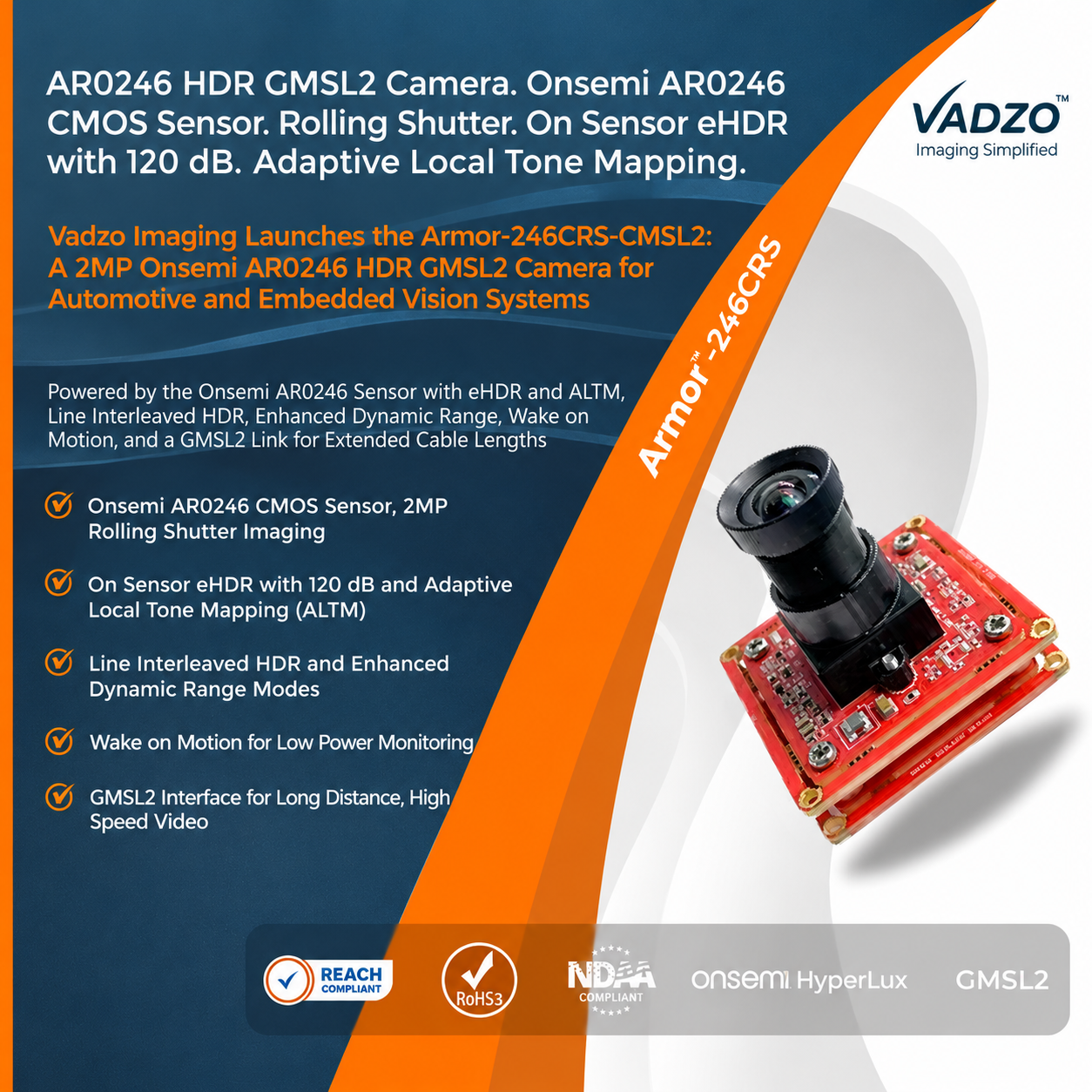

The Armor-246CRS-GMSL2 is a 2MP Onsemi AR0246 HDR GMSL2 Camera, and Vadzo Imaging is launching it for automotive and embedded vision systems.
FORT WORTH, TX, UNITED STATES, November 6, 2026 /EINPresswire.com/ — Vadzo Imaging, a provider of embedded vision camera products for OEMs and system integrators, today launches the Armor-246CRS-GMSL2, an AR0246 HDR GMSL2 Camera built on the Onsemi AR0246 sensor. Part of Vadzo’s SerDes camera portfolio, the module combines on-sensor eHDR with up to 120 dB dynamic range, Adaptive Local Tone Mapping, line-interleaved HDR, enhanced dynamic range, wake on motion, and a GMSL2 interface for extended cable lengths. With this launch, Vadzo presents a 2MP HDR GMSL2 Camera for dashboard, security, facial recognition, and wearable systems, together with guidance on tone mapping, link bandwidth, and low-power operation.
Why an AR0246 HDR GMSL2 Camera Must Compress a Wide Scene Without Losing Detail
Real-world scenes can contain extreme brightness differences. A bright sky, sunlit road, shaded underpass, and dark vehicle interior may appear in the same frame. A conventional sensor may lose highlight or shadow details when exposure is optimized for only one part of the scene. High dynamic range sensors capture a wider brightness range, but that information must still be converted into an image that a display or processing system can use.
Global tone mapping applies one brightness curve across the entire image. Although it maintains a consistent overall appearance, it can reduce local contrast and hide details in shadows or highlights. Local tone mapping adjusts image regions separately, helping preserve details in both areas. Adaptive Local Tone Mapping also responds to changing scenes. However, its strength must be tuned to avoid halos around bright edges and unnatural brightness transitions.
Power consumption and cable distance introduce additional design considerations. Dashboard and security cameras may spend long periods monitoring quiet scenes, making low-power operation useful. Cameras may also be installed away from the host processor on windshields, poles, door frames, or wearable equipment. Their connections must carry video reliably while handling vibration and electrical noise. GMSL2 provides a transmission interface designed for automotive and industrial environments.
System integrators need a camera that combines HDR, low-power capabilities, and a robust transmission interface. Evaluating the camera with actual scenes, cable lengths, and host hardware early in development can help reduce integration changes later.
How an AR0246 HDR GMSL2 Camera Maps 120 dB into a Usable Picture
The Armor-246CRS-GMSL2 uses the Onsemi AR0246, a 2MP color rolling shutter sensor with on-sensor eHDR. Its dynamic range reaches up to 120 dB, representing a brightness ratio of approximately one million to one. The sensor also supports line-interleaved HDR (LI-HDR), which alternates exposure settings across image rows, and enhanced dynamic range (eDR), a lighter mode for scenes with moderate contrast. Since the sensor reads image rows sequentially, the camera uses rolling shutter operation.
A 120 dB range is approximately 20 bits when represented linearly. By comparison, an 8-bit display provides 256 brightness levels, equivalent to approximately 48 dB of linear range. Tone mapping compresses the captured information into a smaller range. Adaptive Local Tone Mapping (ALTM) adjusts the mapping region by region, helping retain shadow details while controlling highlights. On-sensor processing provides an already mapped image to the host, potentially reducing host processing requirements. Teams requiring the full captured range for their algorithms should confirm the available output options.
Wake on motion allows the sensor to remain in a low-power state and resume capture when activity is detected. This can support parked dashboard recording and security installations monitoring quiet areas. However, system designers should measure the time between motion detection and the first usable frame. Sensor recovery, exposure adjustment, serializer and deserializer operation, and host processing can all affect timing. Actual power savings also depend on the rest of the system.
GMSL2, or Gigabit Multimedia Serial Link 2, transmits video through a forward channel and control information through a reverse channel over coaxial cable or shielded twisted pair. Its nominal forward data rate can reach up to 6 Gbps. As an illustrative example, an uncompressed 2MP, 8-bit YUV422 stream at 30 frames per second requires approximately 1 Gbps. Actual output formats and frame rates should be confirmed against product documentation. Cable assemblies should also be tested in the intended electrical environment, particularly near motors and inverters.
Local tone mapping involves trade-offs. Increasing shadow brightness can also make image noise more visible, while aggressive local contrast adjustments may create halos around bright edges. Adaptation that responds too quickly can cause visible brightness changes when objects enter the frame. Teams should evaluate the mapping with real footage and compare processing modes, particularly when the output feeds computer vision or perception algorithms.
Product Overview
The Armor-246CRS-GMSL2 is a 2MP color GMSL2 camera module built on the Onsemi AR0246 sensor for automotive and embedded vision systems. As a 2MP High Dynamic Range GMSL2 Camera, it captures up to 120 dB dynamic range on the sensor and transmits image data through a GMSL2 interface.
The module is also an AR0246 Rolling Shutter GMSL2 Camera, describing its sensor readout, and a 2MP Rolling Shutter GMSL2 Camera. It combines the sensor with a GMSL2 serializer for designs requiring extended cable connections. Other descriptions include AR0246 HDR GMSL2 Camera Module, 2MP GMSL2 Camera Module, AR0246 High Dynamic Range Camera, 2MP HDR Coax GMSL2 Camera, and Automotive Embedded Vision HDR GMSL2 Camera.
Key Capabilities of the AR0246 HDR GMSL2 Camera
Key specs: 2MP maximum resolution | Onsemi AR0246 CMOS sensor | Color rolling shutter | GMSL2 SerDes interface | On-sensor eHDR up to 120 dB with ALTM | Lens per module configuration.
On Sensor eHDR up to 120 dB
The sensor combines exposure information on the chip and supports up to 120 dB dynamic range. This helps capture scenes containing bright and dark areas, such as a vehicle entering a tunnel or a camera viewing a shaded interior against direct sunlight. On-sensor processing provides a combined image to the host. Teams should evaluate the feature using real scenes and confirm the dynamic range figure against product documentation.
Adaptive Local Tone Mapping
Adaptive Local Tone Mapping compresses a wide scene brightness range into a usable image while adjusting the curve across different regions. It helps retain detail in shadows and highlights and adapts as scene conditions change. Since strong local adjustments can create halos, integrators should test the feature using representative scenes, including faces against bright windows and roads under bright skies.
Line Interleaved HDR
Line-interleaved HDR alternates exposure settings across image rows within a frame and combines the captured information. This helps represent bright and dark regions together without relying on sequential exposure frames. The technique has trade-offs, including a potential reduction in vertical detail. Teams should compare its output with other available modes using their own moving scenes.
Enhanced Dynamic Range
Enhanced dynamic range, or eDR, is intended for scenes with moderate contrast, such as indoor environments with window lighting or roads under overcast skies. It provides an alternative to more aggressive HDR modes. Integrators can evaluate the appropriate mode for different lighting conditions during system development.
Wake on Motion
Wake on motion allows the sensor to remain in a low-power state and resume capture when movement is detected. This can reduce sensor energy use and heat in enclosed camera housings. It is relevant to parked dashboard recording and security systems monitoring quiet areas. Motion thresholds should be tested at the installation site to reduce false activations from shadows, lights, or moving branches. The time to the first usable frame should also be measured across the complete camera link.
GMSL2 for Long Distance Transmission
GMSL2 carries high-speed video over a forward channel and control information over a reverse channel. It supports coaxial cable or shielded twisted pair and is designed for automotive and industrial environments where electrical noise is a consideration. This allows a camera to be installed away from the host processor while maintaining a high-speed connection. As a 2MP GMSL2 Camera Manufacturer and AR0246 HDR GMSL2 Camera Manufacturer, Vadzo supports integrators with deserializer selection, cable planning, firmware customization, and enclosure design.
Rolling Shutter Readout
The AR0246 uses rolling shutter readout, capturing image rows sequentially. This provides a practical solution for many embedded imaging applications. Fast lateral movement or strong vibration can introduce image skew, depending on exposure and scene conditions. A shorter exposure may reduce the visible effect. Vadzo also offers global shutter modules for applications where fast motion is a primary concern.
“High dynamic range is only half the job. Once a sensor records a million to one, that information must be converted into a picture that a person or an algorithm can use. The Armor-246CRS-GMSL2 combines on-sensor eHDR with Adaptive Local Tone Mapping and a GMSL2 interface for extended cable connections. We encourage customers to evaluate tone mapping with real scenes, measure wake timing on the complete link, and confirm operating details against product documentation. Our team supports customers with system planning and evaluation across dashboard, security, and wearable applications.” — Alwin Vincent, Product Manager, Vadzo Imaging
HDR and Low Power Imaging Application
Dashboard Camera Systems
Dashboard cameras encounter changing brightness when vehicles move between direct sunlight, tunnels, and shaded interiors. The Armor-246CRS-GMSL2 can serve as an In-Vehicle HDR GMSL2 Camera for capturing road and cabin scenes with ALTM. It can also support rearview camera designs where headlights may affect image visibility. As a Driver Monitoring GMSL2 Camera, it can support designs that capture the driver’s face against bright windows. Wake on motion supports parked-mode applications. Integrators should evaluate total system power, including the recorder and link electronics, rather than considering sensor power alone. Testing across tunnels and low-sun conditions helps assess image performance.
Smart Security Systems
Security cameras installed at entrances and perimeter locations may need to capture bright outdoor areas and darker interiors in one scene. The module’s HDR capabilities and local tone mapping can help retain image details across these lighting conditions. Wake on motion may support installations monitoring quiet areas. Integrators should tune motion thresholds to reduce false activations and test image performance at different times of day.
Facial Recognition Systems
Faces at entrances and gates may be backlit by windows or bright outdoor environments. HDR with local tone mapping can help maintain facial visibility while controlling background highlights. The 2MP image output can support camera designs for gate and access-control systems, but recognition accuracy depends on the complete software, optics, lighting, and installation. Privacy, legal, and fairness responsibilities remain with the solution provider and operator. Testing should use representative subjects and actual site lighting.
Wearable and Embedded Systems
Wearable and head-mounted devices may separate a camera module from a processing unit. A coaxial cable can connect the camera to the host while allowing the processing hardware to be positioned elsewhere. The Armor-246CRS-GMSL2 can support embedded vision designs that encounter changing indoor and outdoor lighting. System developers should assess cable flexibility, connector retention, module weight, and housing design under expected operating conditions. Vadzo can assist with harness and enclosure evaluation.
Frequently Asked Questions
Q: What is tone mapping, and why does an HDR camera need it?
A: A high dynamic range sensor records a wider range of brightness than a typical display can reproduce. A 120 dB scene represents approximately a million-to-one brightness ratio, while an 8-bit display provides 256 levels. Tone mapping compresses the captured range into a displayable image. Local tone mapping adjusts different image regions to help preserve shadow and highlight details. A 2MP HDR GMSL2 Camera with on-sensor processing can provide an already mapped image to the host.
Q: Is HDR processing better on the sensor or on the host computer?
A: Both approaches have advantages. On-sensor processing combines and maps the image before transmission, reducing the processing required by the host. Host-based processing can provide more control and access to image information, depending on the available output. Integrators should confirm output options when their algorithms require access to the full captured range.
Q: Can a dashboard camera sleep and still catch an event?
A: Wake on motion allows the sensor to remain in a low-power state and resume capture when activity is detected. The first usable frame depends on sensor recovery, exposure adjustment, link operation, and the recorder. Vadzo recommends measuring wake timing on the complete system and tuning the motion threshold to reduce false activations.
Q: Does HDR help a facial recognition system?
A: HDR can help when faces are backlit by windows or bright outdoor environments. Local tone mapping can improve facial visibility while controlling background highlights. However, recognition accuracy depends on the software, lens, lighting, and installation. Privacy and fairness responsibilities belong to the solution provider and operator.
Q: Why should integrators choose Vadzo Imaging as their 2MP GMSL2 Camera Manufacturer?
A: Vadzo Imaging offers a camera module combining on-sensor eHDR, Adaptive Local Tone Mapping, wake on motion, and a GMSL2 interface. The company also provides engineering support for lens selection, cable planning, deserializer configuration, firmware customization, and enclosure design. Evaluation options allow integrators to test their own scenes and cable runs before moving to volume production.
Availability
The Armor-246CRS-GMSL2, an AR0246 HDR GMSL2 Camera built on the Onsemi AR0246 sensor, is available for evaluation and production orders. Evaluation configurations can include the camera module, lens, cable, and platform documentation, subject to confirmation. Integrators can assess tone mapping using their own scenes, measure wake timing on target systems, and test cable performance in their operating environments before finalizing a production design.
Customers requiring a different lens, cable, or deserializer configuration can contact Vadzo Imaging to discuss their requirements. Explore Vadzo’s camera portfolio at www.vadzoimaging.com or email support@vadzoimaging.com to request an evaluation unit or discuss OEM integration requirements.
About Vadzo Imaging
Vadzo Imaging is a global provider of embedded vision solutions, offering camera technologies and imaging platforms for robotics, industrial automation, UAVs, edge AI, and medical systems. Its products are designed for integration with leading embedded platforms, including NVIDIA Jetson, Rockchip, Raspberry Pi, and NXP i.MX. Vadzo supports customers through hardware customization, firmware development, and module-level drivers across MIPI, USB, GigE, Wi-Fi, GMSL2, and SerDes camera interfaces.
Alwin Vincent
Vadzo Imaging
+1 817-678-2139
alwin@vadzoimaging.com
Visit us on social media:
LinkedIn
YouTube
X
Legal Disclaimer:
EIN Presswire provides this news content “as is” without warranty of any kind. We do not accept any responsibility or liability
for the accuracy, content, images, videos, licenses, completeness, legality, or reliability of the information contained in this
article. If you have any complaints or copyright issues related to this article, kindly contact the author above.

Media gallery


