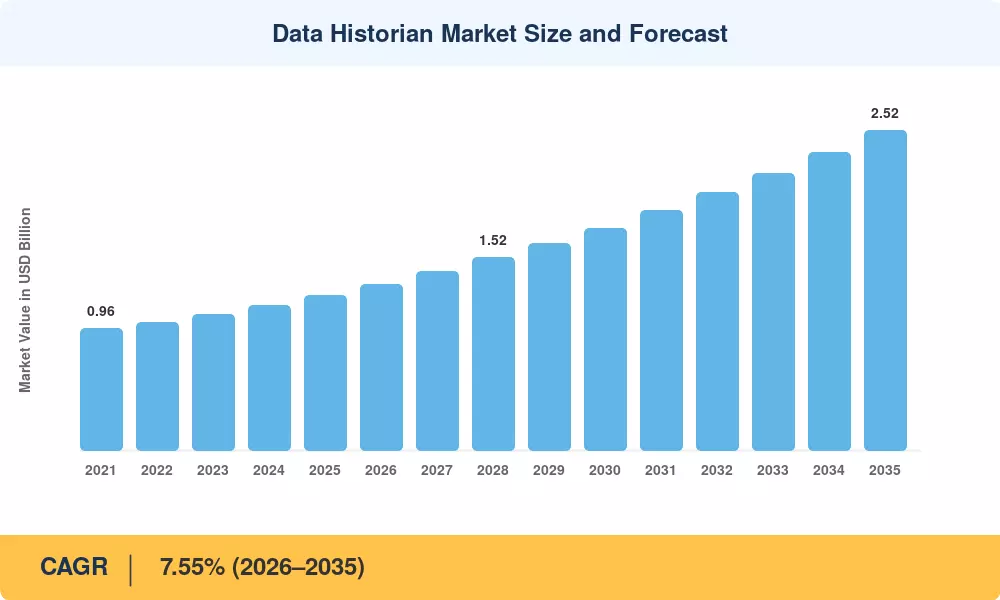
Data Historian Market to Surge at 7.55% CAGR, Anticipated to Reach USD 2.52 Billion by 2035
Data Historian Market growth is driven by industrial automation, real-time analytics, IoT adoption, and rising demand

Press Release Disclaimer: This is a press release distributed through the XPR Media network. It has not been independently verified by our newsroom.


Data Historian Market growth is driven by industrial automation, real-time analytics, IoT adoption, and rising demand for efficient data management.
NEW YORK(NY), NY, UNITED STATES, August 31, 2026 /EINPresswire.com/ — The Data Historian Market was valued at USD 1.22 Billion in 2025 and is projected to reach USD 1.31 Billion in 2026 before rising to USD 2.52 Billion by 2035, reflecting a 7.55% CAGR during 2026–2035. Data historians are increasingly becoming essential for capturing, storing, contextualizing, and analyzing time-series information generated by industrial assets. The expansion of industrial automation, connected equipment, and operational data environments is strengthening demand across manufacturing, energy, utilities, chemicals, oil and gas, and data centers.
North America maintains the leading position, accounting for 32.6% of revenue in 2025, supported by established industrial automation infrastructure and widespread adoption of operational data technologies. Europe follows with approximately USD 0.33 Billion in 2025, while Asia-Pacific is emerging as the fastest-growing regional market with an 8.8% CAGR through 2035. These regional dynamics demonstrate the increasing importance of real-time industrial intelligence, digital transformation, and connected asset management across mature and developing economies.
Download Sample Pages of Research Overview –
https://www.marketresearchfuture.com/sample_request/8301
Data Historian Industry Landscape
Data historian solutions function as specialized repositories for high-frequency operational information collected from machines, sensors, control systems, production lines, and industrial equipment. Unlike conventional databases, these platforms are designed to preserve time-stamped process information while maintaining engineering context and data quality. As industrial organizations generate larger quantities of telemetry, historians are becoming a foundational layer connecting operational technology with enterprise analytics, cloud platforms, artificial intelligence, and industrial Internet of Things environments.
The industry is also shifting from traditional standalone archival systems toward hybrid and connected architectures. Organizations increasingly want to maintain low-latency data collection at the plant or edge while transferring selected information to enterprise data lakes and cloud analytics platforms. This transition is creating demand for interoperable historian solutions capable of supporting multiple protocols, scalable storage, secure connectivity, and advanced analytics. Such developments are reinforcing the role of historians as an operational data backbone rather than simply a long-term archive.
Key Market Growth Drivers
The increasing adoption of Industrial IoT is one of the strongest contributors to Data Historian Market growth. Modern production environments contain thousands of sensors capable of continuously generating information related to temperature, pressure, vibration, energy consumption, production output, and equipment condition. Data historians allow organizations to preserve these measurements and analyze historical patterns, helping engineers identify inefficiencies, investigate incidents, and improve asset performance. The growing number of connected devices therefore directly increases demand for reliable time-series data management.
Another important driver is the increasing convergence of operational technology and information technology. Manufacturing and infrastructure companies are connecting plant-floor systems with enterprise applications to improve visibility and decision-making. Data historians provide a controlled mechanism for transferring operational information from industrial environments into analytics systems. This capability supports predictive maintenance, production optimization, quality monitoring, energy management, and performance benchmarking while helping organizations create a more integrated digital operating environment.
AI and Predictive Analytics Adoption
Artificial intelligence and machine learning are creating a significant new application layer for historical industrial data. Predictive models require large quantities of reliable and contextualized information to identify equipment anomalies, forecast failures, optimize production parameters, and improve resource utilization. Data historians provide years of time-stamped operational information that can serve as an important foundation for these models. Consequently, industrial organizations are increasingly viewing historical process data as a strategic asset rather than merely stored operational information.
The relationship between historians and advanced analytics also creates opportunities similar to developments seen across the Adaptive Learning Market, where continuous data collection and feedback support intelligent decision-making. For industrial organizations, however, the objective is to continuously learn from machine behavior, production conditions, and historical events. Better integration between historians, AI platforms, digital twins, and analytics applications can therefore create more responsive industrial environments and improve operational intelligence.
Cloud and Hybrid Deployment Trends
Cloud adoption is changing how organizations deploy and manage data historian capabilities. Traditional on-premise installations remain important because industrial environments often require local processing, low latency, security, and operational continuity. However, cloud-based platforms are gaining attention because they enable multi-site data consolidation, scalable analytics, remote monitoring, and easier access to enterprise applications. Hybrid architectures are consequently becoming attractive for organizations that need both local control and centralized intelligence.
The growing availability of subscription-based software models is also influencing purchasing decisions. Instead of investing exclusively in large upfront infrastructure deployments, businesses can increasingly adopt scalable solutions based on data volume, connected assets, users, or services. This model can simplify expansion across multiple facilities and support gradual digital transformation. As industrial companies modernize legacy infrastructure, the combination of cloud connectivity and flexible commercial models is expected to create additional opportunities for historian vendors.
Data Historian Market Opportunities
Data centers represent an emerging opportunity because operators increasingly need to monitor power consumption, cooling performance, temperature, equipment utilization, and environmental conditions. The latest industry assessment identifies data centers as one of the fastest-growing end-user areas, with a projected 9.4% CAGR through 2035. Historian technologies can consolidate high-frequency telemetry from electrical systems, cooling infrastructure, generators, and other critical equipment, supporting performance optimization and operational reliability.
Emerging economies also provide substantial greenfield opportunities because newly constructed industrial facilities can implement modern data architectures without carrying extensive legacy-system constraints. Countries across Asia-Pacific, including India and other rapidly industrializing economies, are investing in manufacturing, energy, infrastructure, and smart facilities. These developments create opportunities for cloud-connected and hybrid historian platforms that can be designed into new facilities from the beginning rather than introduced through complex migration projects.
Segment Analysis by Component
Software remains the dominant component of the Data Historian Market, accounting for approximately 61.5% of revenue in 2025. Core historian platforms provide the infrastructure needed to capture, compress, organize, retrieve, and contextualize industrial time-series information. Their integration with control systems and operational applications makes software an essential part of modern industrial data architectures. Meanwhile, services are projected to expand at a faster pace, supported by migration, implementation, cybersecurity, integration, and governance requirements.
Services are becoming increasingly valuable as organizations modernize complex legacy environments. Professional and managed services can assist with system deployment, data migration, architecture design, cybersecurity hardening, integration, maintenance, and workforce training. Large industrial facilities often operate multiple generations of equipment and control platforms, making integration more complicated than simply installing new software. Consequently, service providers and systems integrators are expected to play a growing role in successful historian modernization programs.
Segment Analysis by Deployment
On-premise deployment continues to dominate because many industrial facilities require localized processing, operational resilience, and direct connectivity with plant-floor systems. The segment represented approximately 65.9% of the market in 2025. Safety requirements, data sovereignty, cybersecurity considerations, and the need for reliable connectivity can make local infrastructure particularly attractive for critical industrial applications.
Cloud deployment, however, is gaining momentum as organizations seek centralized monitoring and analytics across geographically distributed facilities. Cloud platforms can help businesses aggregate information from multiple plants and make historical data available to enterprise analytics teams. The future is therefore likely to involve greater coexistence between on-premise and cloud environments, with local systems handling operational collection while cloud platforms provide broader analytics, visualization, artificial intelligence, and enterprise-level reporting.
End-User Industry Insights
Oil and gas remains a major end-user industry, representing approximately 25.7% of Data Historian Market demand in 2025. Refineries, production facilities, pipelines, and processing plants generate large quantities of time-series information that can be used for asset monitoring, production optimization, process safety, and predictive maintenance. The sector’s extensive installed base of industrial control systems provides a strong foundation for continued historian adoption and modernization.
Other important industries include power and utilities, chemicals and petrochemicals, metals and mining, paper and pulp, pharmaceuticals, manufacturing, and data centers. Each sector generates different operational requirements, but all benefit from reliable historical records. For example, utilities can analyze equipment and grid performance, mining companies can monitor remote assets, and pharmaceutical manufacturers can maintain detailed production records. This broad applicability gives historian vendors opportunities to diversify beyond traditional process industries.
Buy Now the Detailed Report –
https://www.marketresearchfuture.com/checkout?currency=one_user-USD&report_id=8301
Regional Market Insights
North America leads the Data Historian Market with a 32.6% revenue share in 2025. The region benefits from established adoption across oil and gas, manufacturing, utilities, chemicals, and data centers, alongside strong investment in industrial digitalization. The United States represents a particularly important national market, supported by extensive industrial infrastructure and increasing demand for asset performance management and predictive maintenance.
Europe represents the second-largest regional contributor, with approximately USD 0.33 Billion in 2025. Demand is supported by industrial automation, sustainability initiatives, cybersecurity requirements, and the modernization of manufacturing and energy infrastructure. Germany, the United Kingdom, France, Italy, and other European economies are important contributors to regional adoption. Meanwhile, Asia-Pacific is projected to achieve the fastest growth at an 8.8% CAGR through 2035, driven by industrial expansion, smart manufacturing, IoT deployment, and new infrastructure investment.
Competitive Landscape
The competitive environment includes established industrial automation and software providers such as AVEVA, GE Vernova, Honeywell, Rockwell Automation, Siemens, Emerson, ABB, Yokogawa, Canary Labs, Inductive Automation, and InfluxData. These companies compete through historian functionality, industrial connectivity, cloud integration, analytics capabilities, cybersecurity, scalability, and integration with broader automation ecosystems. Vendors are increasingly positioning historian platforms as part of comprehensive industrial data-management and digital-transformation portfolios.
Competition is also being shaped by the transition toward open and interoperable architectures. Customers increasingly expect historian systems to connect with industrial protocols, streaming platforms, cloud environments, enterprise data lakes, and AI applications. Vendors capable of combining reliable high-speed data collection with contextualization, flexible deployment, strong cybersecurity, and accessible analytics are likely to maintain an advantage as industrial customers move toward data-centric operations.
Key Challenges and Market Barriers
Despite strong growth prospects, the Data Historian Market faces several challenges. Legacy infrastructure can make modernization costly and complicated, particularly when facilities contain equipment from multiple vendors and technology generations. Data quality, inconsistent tagging, integration limitations, cybersecurity risks, and a shortage of skilled industrial data professionals can also delay implementation. Organizations must therefore evaluate not only software capabilities but also migration requirements, governance, connectivity, and long-term maintenance costs.
Cybersecurity is another critical consideration because historians can become an important connection point between operational technology and enterprise environments. Expanding connectivity increases the potential attack surface, making secure architecture, authentication, access control, segmentation, monitoring, and compliance increasingly important. Vendors must balance accessibility with operational security while ensuring that historian systems can continue functioning reliably in critical environments.
Future Outlook
The future of the Data Historian Market is expected to center on AI-ready industrial data, hybrid architectures, advanced analytics, and greater interoperability. Historians are likely to evolve from passive repositories into intelligent data platforms that contextualize information and make it immediately usable by analytics and AI systems. Integration with digital twins, machine learning, industrial cloud platforms, and real-time dashboards will further expand the strategic value of historical operational information.
The market is projected to reach USD 2.52 Billion by 2035 at a 7.55% CAGR, indicating steady long-term expansion. Growth will be supported by Industrial IoT adoption, OT/IT convergence, predictive maintenance, energy monitoring, sustainability reporting, and the increasing need for operational transparency. As businesses recognize the value of historical industrial data, historian technologies are expected to become an increasingly important component of connected and intelligent industrial ecosystems.
Browse In-depth Market Research Report –
https://www.marketresearchfuture.com/reports/data-historian-market-8301
Key Takeaways
The Data Historian Market is moving beyond traditional industrial data archiving toward an integrated operational intelligence platform. North America currently leads with a 32.6% share, while Asia-Pacific provides the strongest growth opportunity at an 8.8% CAGR. Software remains the largest component, on-premise deployment continues to dominate, and data centers are emerging as a high-growth application area. These trends highlight the increasing importance of reliable historical data for industrial automation, AI, predictive analytics, and digital transformation.
➤➤Frequently Asked Questions:
What is a Data Historian?
A data historian is specialized software that collects, stores, timestamps, and organizes historical operational data generated by industrial systems and equipment.
What is driving the Data Historian Market?
Industrial IoT, automation, predictive maintenance, OT/IT convergence, AI adoption, and increasing demand for operational analytics are major growth drivers.
Which region leads the Data Historian Market?
North America leads with a 32.6% revenue share in 2025.
Which region is growing fastest?
Asia-Pacific is projected to record the fastest CAGR at 8.8% during 2026–2035.
What is the market size in 2035?
The market is projected to reach USD 2.52 Billion by 2035.
Which industry is a major user?
Oil and gas is a leading end-user industry, accounting for about 25.7% of demand in 2025.
Is cloud deployment growing?
Yes. Cloud deployment is expanding as organizations seek scalable analytics, centralized monitoring, and multi-site data integration.
Why is historical industrial data important for AI?
Historical data provides the time-series information needed to train predictive models, identify patterns, and optimize industrial operations.
➤➤Explore Regional and Country-Level Reports for the Main Keyword to Gain Deeper Market Insights.
Canada Data Historian Market-
https://www.marketresearchfuture.com/reports/canada-data-historian-market-64942
China Data Historian Market-
https://www.marketresearchfuture.com/reports/china-data-historian-market-64947
Europe Data Historian Market-
https://www.marketresearchfuture.com/reports/europe-data-historian-market-64945
France Data Historian Market-
https://www.marketresearchfuture.com/reports/france-data-historian-market-64941
Gcc Data Historian Market-
https://www.marketresearchfuture.com/reports/gcc-data-historian-market-64943
Germany Data Historian Market-
https://www.marketresearchfuture.com/reports/germany-data-historian-market-64939
India Data Historian Market-
https://www.marketresearchfuture.com/reports/india-data-historian-market-64946
Italy Data Historian Market-
https://www.marketresearchfuture.com/reports/italy-data-historian-market-64944
Japan Data Historian Market-
https://www.marketresearchfuture.com/reports/japan-data-historian-market-64940
Spain Data Historian Market-
https://www.marketresearchfuture.com/reports/spain-data-historian-market-64948
Uk Data Historian Market-
https://www.marketresearchfuture.com/reports/uk-data-historian-market-64938
Us Data Historian Market-
https://www.marketresearchfuture.com/reports/us-data-historian-market-12866
Market Research Future
Market Research Future
+ +1 855-661-4441
email us here
Legal Disclaimer:
EIN Presswire provides this news content “as is” without warranty of any kind. We do not accept any responsibility or liability
for the accuracy, content, images, videos, licenses, completeness, legality, or reliability of the information contained in this
article. If you have any complaints or copyright issues related to this article, kindly contact the author above.

Media gallery