WiBiz Analysis: The Real Risk in Automation Is the Failure Nobody Sees
New analysis explains why business owners need a clear record of what their systems did, plus a human stop before

Press Release Disclaimer: This is a press release distributed through the XPR Media network. It has not been independently verified by our newsroom.
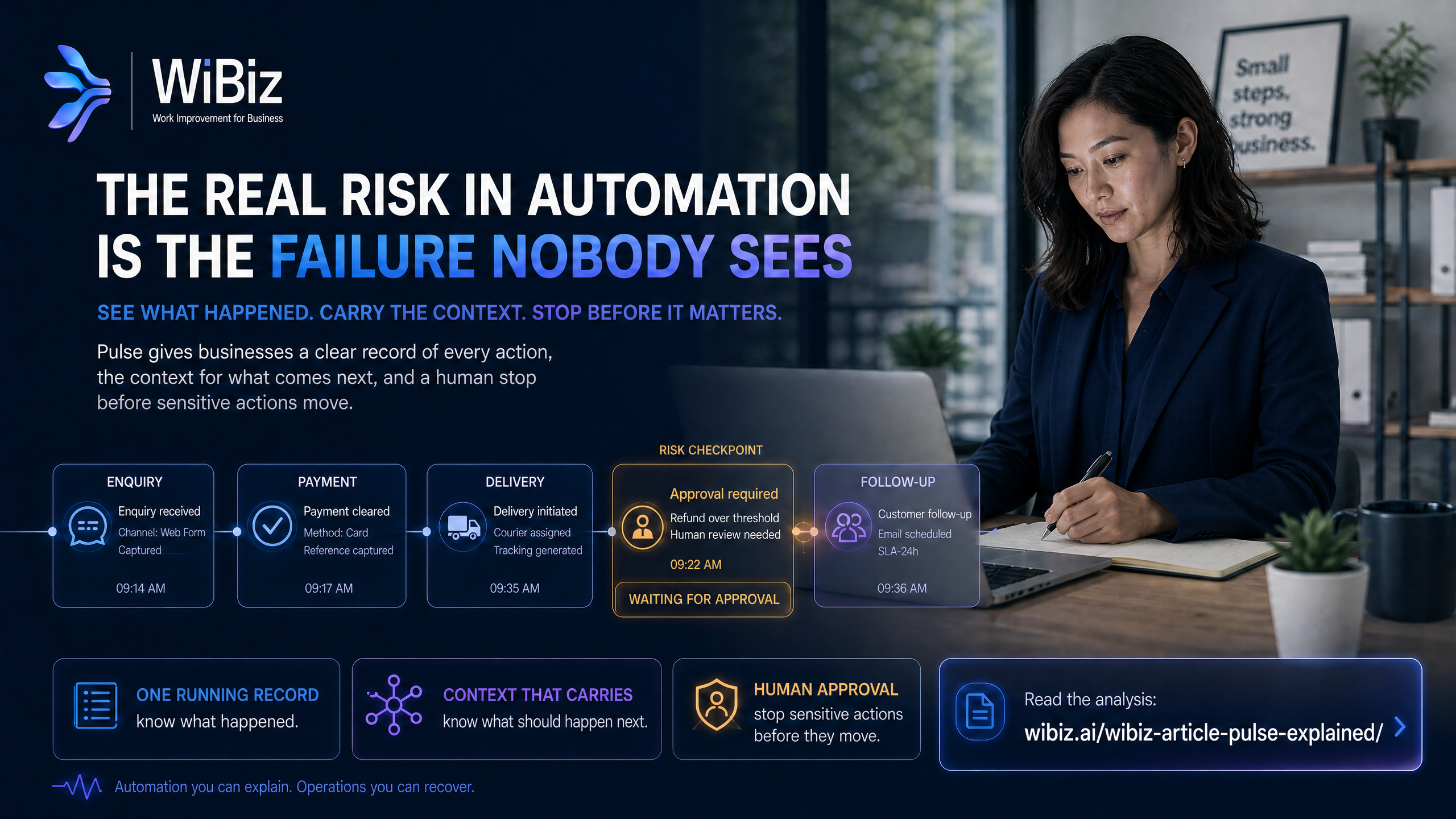

New analysis explains why business owners need a clear record of what their systems did, plus a human stop before customer or payment actions.
111 NORTH BRIDGE ROAD, #07-09, PENINSULA PLAZA, SINGAPORE, September 3, 2026 /EINPresswire.com/ — A customer pays, but a reminder still goes out. A booking is cancelled, but the next message fires anyway. A promising enquiry disappears between the inbox and the calendar. In each case, the deepest problem is not that a workflow failed. It is that the business discovered the failure only after a customer did.
WiBiz has published a new analysis for small and midsize business leaders on this quiet operational risk. The article, “Pulse Explained for Business Leaders,” argues that automation is only useful when the business can see what happened, carry the right context into the next step, and stop before a sensitive action is taken.
The timing reflects a widening gap between interest and operational confidence. Singapore’s Ministry of Manpower reported in April 2026 that 28.5 percent of firms had started adopting AI, but only 3.8 percent had integrated it into core processes. The Singapore Business Federation’s National Business Survey 2025 Digitalization Supplement, released in February 2026, also found that automation ranked among the top three developments businesses are most concerned with over the next 12 months, while cost, expertise, and data privacy and security remained the leading barriers to adoption.
The article uses Pulse, the operating system WiBiz runs in its own business, to show what that discipline looks like in practice. Pulse keeps one running record of the work. When an enquiry arrives, a payment clears, delivery changes, or a customer replies, the action can be recorded against the same business history instead of disappearing inside separate tools.
That record gives the next step context. A customer who already paid should not be treated as unpaid. A person who cancelled should not receive the next booking message. A completed action should not be repeated simply because the workflow retried. Defined actions that touch money, publishing, scope, or a customer relationship can be held for a named person to approve, with the decision and supporting evidence kept on the record.
The underlying method is event sourcing, but the business value is straightforward: the owner can answer what happened, what should happen next, what was stopped, and who approved the exception. The system is designed around recovery and accountability, not only speed.
WiBiz says this is the distinction between adding another automation and installing an operating layer. The first performs a task. The second carries the working chain across enquiry, payment, delivery, and follow-up while preserving a readable account of the handoffs.
The full analysis is available at https://wibiz.ai/wibiz-article-pulse-explained/
About WiBiz
WiBiz builds operating systems for small and midsize businesses. Its work connects customer enquiries, qualification, booking, payment, delivery, and follow-up into one working chain shaped around how each business actually operates.
More information is available at https://wibiz.ai/.
Nicklaus D’Cruz
hello@wibiz.ai
WiBiz
Visit us on social media:
LinkedIn
Instagram
Facebook
Legal Disclaimer:
EIN Presswire provides this news content “as is” without warranty of any kind. We do not accept any responsibility or liability
for the accuracy, content, images, videos, licenses, completeness, legality, or reliability of the information contained in this
article. If you have any complaints or copyright issues related to this article, kindly contact the author above.

Media gallery