Putting a price on preventive care: How Medicaid compares to other insurers in Virginia
Study led by George Mason University found that two forms of Medicaid paid less for routine preventive visits than

Press Release Disclaimer: This is a press release distributed through the XPR Media network. It has not been independently verified by our newsroom.

Study led by George Mason University found that two forms of Medicaid paid less for routine preventive visits than other major types of insurance
FAIRFAX, VA, UNITED STATES, September 4, 2026 /EINPresswire.com/ — Medicaid has a reputation for paying doctors less than other health insurers. But exactly how much less has been difficult to establish, particularly for the vast majority of Medicaid patients whose care is provided through private health plans.
A new Virginia study led by George Mason University professor Alison Cuellar now offers a clearer comparison. Cuellar and colleagues examined how much different types of insurance paid doctors for the same routine preventive visits, allowing them to directly compare two forms of Medicaid—“fee for service” and “managed care”—with other major types of health insurance, such as employer-sponsored insurance.
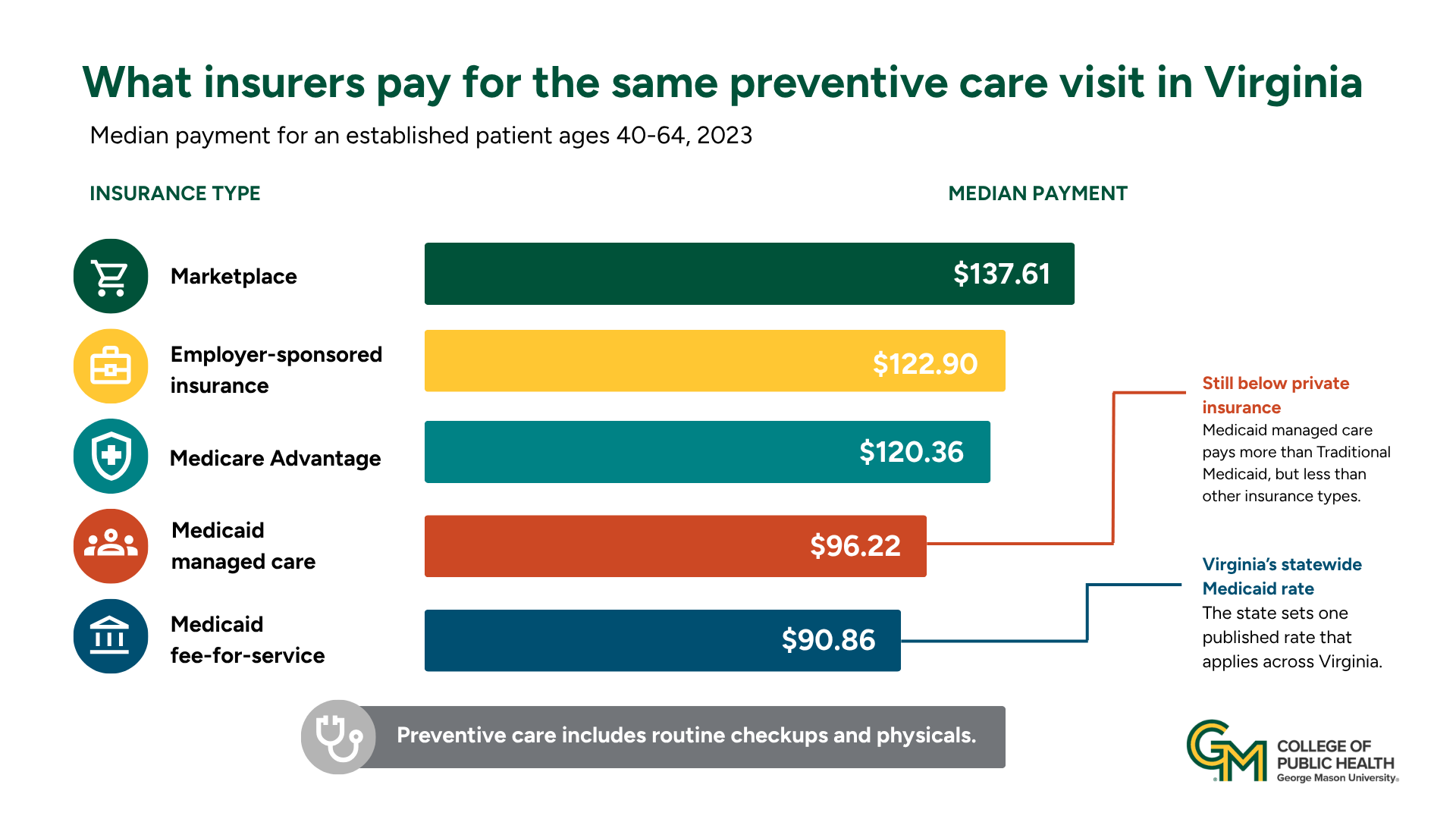
The study, published in JAMA Health Forum, found a consistent divide: both forms of Medicaid paid substantially less than the other types of insurance studied. Even Medicaid private managed care plans paid 25% less than Medicare plans and more than 40% less than marketplace plans, even though they generally paid more than the state’s traditional Medicaid program.
About 85% of Medicaid members nationwide are enrolled in Medicaid managed care, in which states contract with private health plans to provide their coverage. Previous studies of Medicaid payment rates have largely focused on traditional fee-for-service Medicaid. To paint a more complete picture this study used novel Transparency in Coverage and Virginia claims data.
“We know that lower payment rates can make doctors less likely to participate in Medicaid, which can make it harder for patients to find care,” said Cuellar, professor of health administration and associate dean of research for the College of Public Health. “But with most Medicaid patients now in managed care, we need to understand what those plans are actually paying and how those rates stack up against other insurers.”
Putting the payment gap in perspective
Knowing how Medicaid payments compare with other forms of insurance gives states a clearer benchmark for evaluating their own rates. But, historically, making that assessment has been challenging due to limited information about both Medicaid managed care rates and what other insurers reimburse for the same services.
More study details
—For a routine preventive visit for an established patient ages 40 to 64, Medicaid managed care plans paid a median rate of $96.22, compared with Virginia’s traditional Medicaid rate of $90.86.
—MedicareAdvantage, employer-sponsored and Marketplace plans all paid significantly more. The researchers found similar patterns for the other preventive visits they studied.
—The findings also suggest that Virginia’s traditional Medicaid rates may serve as an anchor for what Medicaid managed care plans pay. That means changes to the state-set rates could potentially influence rates for managed care, where most Medicaid members receive their coverage.
—The Robert Wood Johnson Foundation’s Health Data for Action program supported this research. Cuellar, the study’s principal investigator, conducted the research with Meredith Young of the Virginia Center for Health Innovation and Jennifer Mellor of William & Mary.
Mary Cunningham
George Mason University College of Public Health
+1 703-993-1931
email us here
Visit us on social media:
LinkedIn
Instagram
Facebook
YouTube
Legal Disclaimer:
EIN Presswire provides this news content “as is” without warranty of any kind. We do not accept any responsibility or liability
for the accuracy, content, images, videos, licenses, completeness, legality, or reliability of the information contained in this
article. If you have any complaints or copyright issues related to this article, kindly contact the author above.

Media gallery